Strategic Design & Management Students at the Virtual Reality Workshop
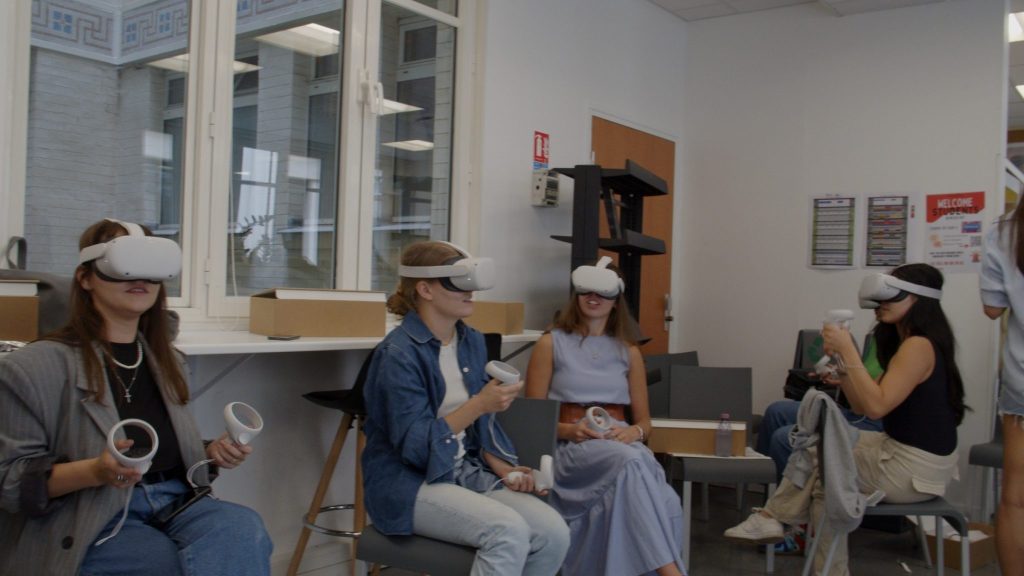
Senior year Strategic Design and Management students at Parsons Paris attended a workshop with Maya Georgieva, Senior Director of Innovation Center at the New School. First she shared insights and examples from the metaverse, her experience in working within innovation and the future of education and digital economy. Getting started with virtual reality, the students set up their meta accounts and experimented with their VR headsets.
This experience also allowed them to discuss aspects of virtual reality such as design principles in a new medium, digital ethics in the metaverse and thinking of it as a catalyst to improve other mediums.
Parsons School of Design Create Digital Spatial Narratives in AR
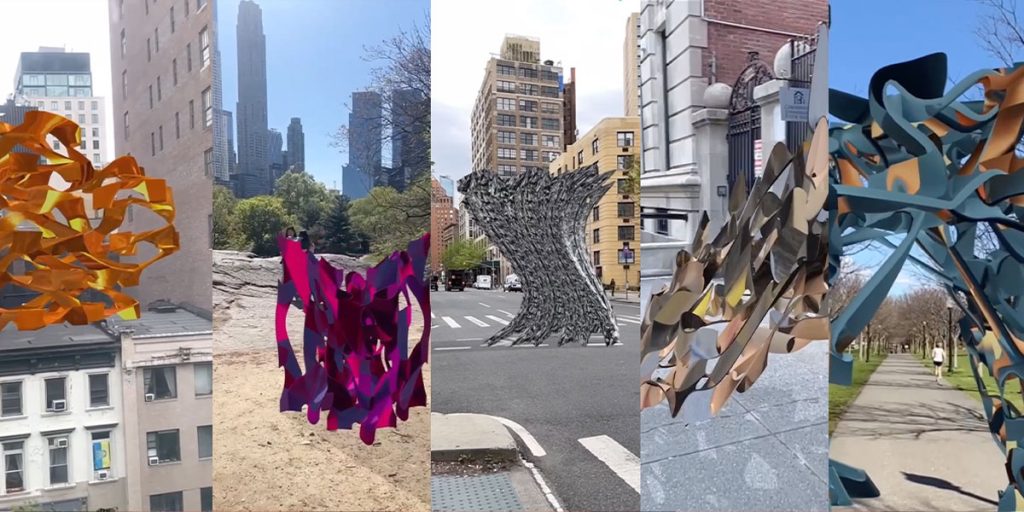
Students from the Digital Spatial Narrative course in the Constructive Environments Program at Parsons School of Design are pushing the boundaries of architecture and design by imagining new landscapes in augmented reality! These new landscapes blend digital models with real-world environments, exploring the juxtaposition of physical architecture and digital design in Augmented Reality.
The Digital Spatial Narrative course was facilitated by Scott Chug and explored Digital and Physical modeling techniques that can be used as tools to test plan- and section-based ideas in architecture and interiors as well as to discover new spatial opportunities in these disciplines. Physical modeling
techniques allow for direct exploration of spatial relationships, direct observation of interactions of surfaces and volumes with light, and direct testing of three-dimensional effects. Digital modeling enables further project development with 3D visualization of light, color, materials, spatial relationships, and details. A series of analytical exercises and in-class workshops will allow students to gain an understanding of baseline techniques while strengthening and reinforcing the learning outcomes achieved in core coursework.
Here is a video from the work students did in the course:
School: Parsons School of Design / School of Constructed Environments
Class Spring 2022: Digital Spatial Narrative
Professor: Hyon Woo Scott Chung
Supporter/Collaborator: Maya Georgieva – Senior Director, Innovation Center, Xreality Lab
Students: Ethan Seemungal, Chevy Chanpaiboonrat, Zhenyuan Qun, Yinjie Shi, Mimi Jarrunpattana, Awassada Ariyaphuttarat, Erika Szapiro, Nia Murray, Kura Yoshino, Nam-Y Nguyen, Ceylin Suner, Brenda Chavez
Maya Georgieva speaks at SXSWedu on Trends & Insights in XR and Immersive Learning
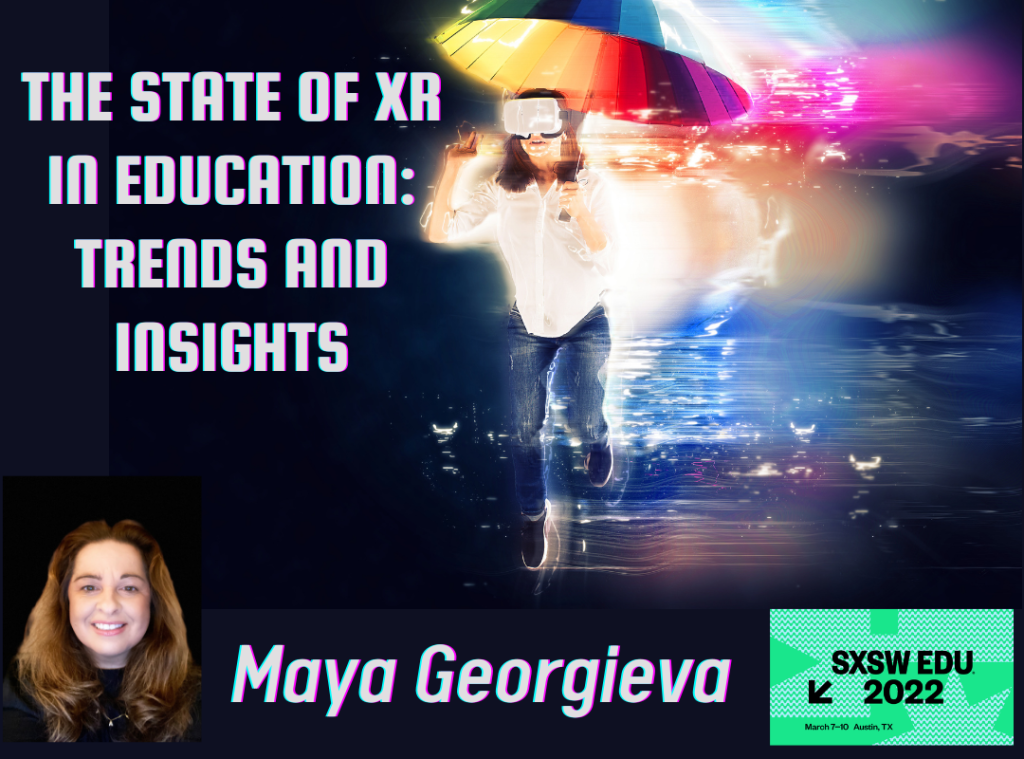
At SXSW Maya Georgieva will deliver the Future20 talk titled The State of XR in Education: Trends & Insights. Starting in 2015 Maya has given the industry and Future20 Talk at SXSW for 5 consecutive times 2015 – 2019. This spring Maya is back on the SXSWedu stage with The State of XR in Education: Trends & Insights.
Her talk will discuss the latest trends and insights in immersive learning drawing on the State of XR and Immersive Learning Report and latest developments to identify the trends that will have the most significant impact on the future of learning and work. The talk will highlight cutting-edge immersive learning projects featuring art, science, museum installations, documentaries, simulations, and games and discusses key design strategies of successful immersive learning projects from across the world.
Spring 2022 Immersive Learning Workshops
XR and The Future of Immersive Learning
With virtual and augmented reality, we are on the cusp of the next wave of the Digital Revolution. Immersive computing will impact multiple areas of culture and society, transforming the way we play, work, communicate, and express ourselves. As we reimagine education in the digital age, immersive experiences may offer us a unique opportunity to transform learning. This session will review recent and upcoming developments in virtual, augmented, and mixed reality as well as a series of projects across the higher education landscape. The session will offer opportunities for questions and discussion. Following the session, faculty will have the opportunity to visit the XReality Center virtual hub.
Date: February, 9th
Time: 3:00 – 4:15pm
Please RSVP
Creating AR with Adobe Aero
Adobe Aero is a Mobile AR authoring application that allows us to create immersive Augmented Reality experiences using a mobile Apple device. With Adobe Aero we will learn how to import 3D content, animate content based on user interactions, designate target surfaces or images, and much more. In this introductory workshop, we will explore the features available in Adobe Aero, mobile AR design, and how to deploy AR experiences on mobile devices. At this time Adobe Aero is only available on iOS devices so an iPhone or iPad are required for this workshop.
Date: February 17,
Time: 4 – 5 pm
Please RSVP
What Is the Metaverse: Hype or Future Reality?
A series of developments over the last two years including a global pandemic has led to increased interest and exploration in virtual worlds from educational, cultural, and industry communities. In this workshop, we will discuss the concept of the Metaverse, Web 3.0, NFTs, and crypto. I will be sharing some projects and there will be ample opportunities for questions and discussion around all that is been taking place in virtual worlds.
Date: March 1nd
Time: 2:00 – 3:15 pm
Please RSVP
Immersive Storytelling with 360 Video
In this interactive workshop, we will review examples of journalism, documentary, and advocacy projects and explore key elements in the design of compelling 360° video experiences to gain a deeper understanding of immersive storytelling. We will discuss and Identify strategies and project-based use cases for the implementation of 360° video in the learning environment and on campus.
Date: March 2nd
Time: 3:00 – 4:15 pm
Please RSVP
Virtual Reality, Digital Literacy, and Ethics
What is the future of digital literacy in a world where the virtual and physical will be equally real? How should literacy be defined when actual human experience is no longer the touchstone for reality? As VR and AR begin to transform the learning environment, we will face profound questions on digital literacy and ethical issues. This session will explore how the growing use of VR will require new forms of digital literacy. We will discuss the expanding importance of privacy, ethics, and cultural sensitivity questions posed by VR and AR. This session will begin with a short presentation leaving ample time for discussion.
Wednesday, March 30th
Time: 3:00 – 4:15 pm
Please RSVP
Immersive Learning Series by Request
Meet with Maya Georgieva to review relevant examples and discuss ways to integrate VR/AR into the teaching and learning environment. Request a custom XR session for your course, department or team. Examples can focus on the use of VR/AR in Design, Humanities, Social Sciences, Environmental Studies, Journalism, Art and Performance or explore and suggest a topic of interest to you. For additional questions contact Maya at maya@newschool.edu
Intro to Unity Workshop
FALL 2021 Immersive Learning Workshops
Virtual Spaces and Galleries for projects and sharing student work facilitated by Maya Georgieva
Join us to see examples and learn about using 3D virtual social spaces and environments for curriculum and extracurricular immersive learning activities. During this session, we will review options for creating virtual class spaces for sharing students’ projects, visiting virtual museums and exhibits, hosting guest speakers, and meeting with students and teams in virtual social worlds.
Date: Thursday, September, 28
Time: 3:00 – 4:15 pm
Please RSVP
XR and The Future of Immersive Learning facilitated by Maya Georgieva
With virtual and augmented reality, we are on the cusp of the next wave of the Digital Revolution. Immersive computing will impact multiple areas of culture and society, transforming the way we play, work, communicate, and express ourselves. As we reimagine education in the digital age, immersive experiences may offer us a unique opportunity to transform learning. This session will review recent and upcoming developments in virtual, augmented, and mixed reality as well as a series of projects across the higher education landscape. The session will offer opportunities for questions and discussion. Following the session, faculty will have the opportunity to visit the XReality Center virtual hub.
Date: Tuesday, October 26
Time: 3:00 – 4:15pm
Please RSVP
Immersive Storytelling with 360 Video facilitated by Maya Georgieva
In this interactive workshop, we will review examples of journalism, documentary, and advocacy projects and explore key elements in the design of compelling 360° video experiences to gain a deeper understanding of immersive storytelling. We will discuss and Identify strategies and project-based use cases for the implementation of 360° video in the learning environment and on campus.
Date: Thursday, November 4th
Time: 3:00 – 4:15 pm
Please RSVP
Virtual Reality, Digital Literacy, and Ethics facilitated by Maya Georgieva
What is the future of digital literacy in a world where the virtual and physical will be equally real? How should literacy be defined when actual human experience is no longer the touchstone for reality? As VR and AR begin to transform the learning environment, we will face profound questions on digital literacy and ethical issues. This session will explore how the growing use of VR will require new forms of digital literacy. We will discuss the expanding importance of privacy, ethics, and cultural sensitivity questions posed by VR and AR. This session will begin with a short presentation leaving ample time for discussion.
Wednesday, November 3rd
Time: 2:00 – 3:15 pm
Please RSVP
Immersive Learning Series by Request
Review relevant examples and discuss ways to integrate VR/AR into the teaching and learning environment. Request a session for your department or team via the request form: Examples can focus on the use of VR/AR in Humanities, Social Sciences, Environmental Studies, Journalism, Art and Design, New Media Narratives or Suggest your own topic. For additional questions contact Maya Georgieva at maya@newschool.edu.
Parsons Design and Technology Alumni Win the 2021 Smithsonian Open Access Challenge
For most people, entering a museum and viewing the works on display doesn’t present any challenges, but for the blind and visually impaired, there are few, if any, options that allow them to experience the paintings, photographs, sculptures, and more that fill a museum.
Recently, the Smithsonian Museum created an Open Access Challenge that will allow users to explore online museum collections by using 2D and 3D digitized assets from the Smithsonian’s Open Access collections. Seven teams were commissioned by Cooper Hewitt’s Interaction Lab to develop new digital interactions and innovative tools that enable play and discovery with the vast dataset, thanks to the support of Verizon 5G Labs.
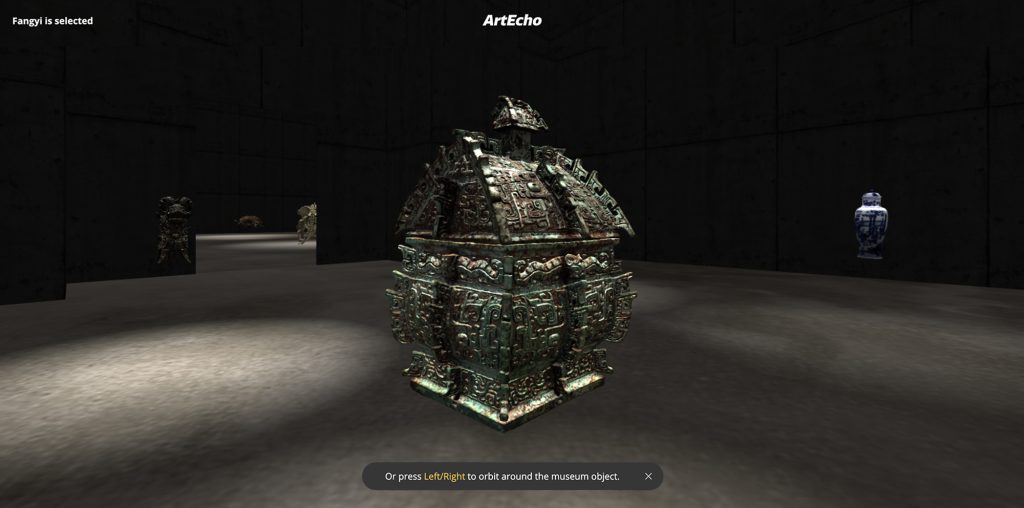
One of the winning projects, ArtEcho, was created by a group of Parsons Design and Technology alumni, including Zhizhen (Jerry) Tan, MFA DT’ 21 who also served as Project Lead, Lan Zhang, MFA DT ‘20, Eraince Wang, MFA DT ‘20, and Benny Zhang, MFA DT ‘21. The group also worked with John Roach, Associate Professor of Fine Arts, and Thomas Tajo, a blind research, echolocation instructor, and President of Vision Inclusive.
Tan was inspired to create ArtEcho in part because as a designer who’s visual-based, he’s afraid of losing his sight, and has worked with the blind and visually impaired communities since his second year in the MFA DT program. The project was also inspired by Tajo, the blind echolocation instructor who served as a team member, and who has been teaching echolocation, a method used by some blind people to navigate and perceive objects, for more than eight years.
“I was inspired to create audio-based digital experiences primarily for sightless audiences’ direct perception, and the Smithsonian challenge gave me a chance to interpret how a digital museum experience might enable people to interact with objects beyond just sight,” explains Tan. “ArtEcho is a web-based virtual reality museum that allows you to perceive museum objects from Smithsonian 3D digitization library and their stories through imagery, sound, verbal narration, and simulated echolocation based on the teachings of Thomas Tajo.”
Tan is hopeful that programs like ArtEcho will provide broader access for echolocation users to perceive the Smithsonian, and other museums’, 3D objects directly through sounds. Tan’s fellow project members agree, emphasizing that the mission of the challenge is meaningful for people from various industries, as the projects touch on all aspects of daily life.
“As a developer and designer, I always seek opportunities to inspire enlightenment and this competition on activating open access provides me a great space to further explore it,” shared Eraince Wang. “Also, I’m attracted by the idea of creating a virtual experience that can include everyone, where I spend more time on learning and practicing on web accessibility development.”
“With accessible and open data and resources that are well categorized and organized by institutions, it really benefits creative and academic individuals to learn, explore, and experiment on their own, which unlocks new possibilities,” explains Lan Zhang. “I personally always look for open-sourced materials to work with when it comes to my creative practice.”
Professor John Roach echoes the alumni he worked with, noting: “In my teaching I like to emphasize the impact that all of our senses have on our experience, so it was great to work on ArtEcho which prioritizes listening. It’s a remarkable tool for blind visitors to engage with objects from the Smithsonian, but it is also a great way for sighted users to learn about echolocation, to activate their sense of hearing and to consider the importance of accessibility.”
All of the Parsons alumni who worked on the project highlighted that their time in the MFA DT program, and at Parsons in general, helped influence their design work, and how they view the role of a designer in the world today. The Parsons curriculum trains designers to break down barriers and constantly innovate in order to create a more just, equitable society, which are principles and values that underscore ArtEcho as well.
“My time at Parsons taught me to embrace wearing multiple hats,” shares Lan Zhang.
“We were encouraged to excel at things we were passionate about and were constantly challenged to innovate and push the boundaries. As part designer and part developer, I enjoy experimenting and taking up projects that aren’t traditionally defined by my role. It makes me always look forward to my next creative excursion. I also love collaborating with my fellow DT friends because we share a very similar mindset.”
ADX Student Group and the XReality Center Create a Virtual Space for Exploring the Creative Possibilities of Anthropological and Design Research
This article was originally published at the The New School Blog

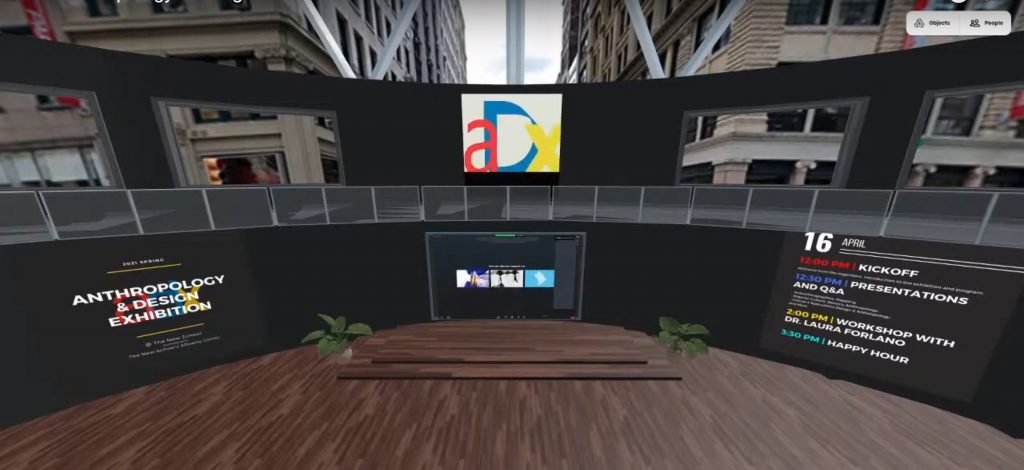
The Anthropology and Design Student Working Group recently held its first ADX Exhibition, presenting student projects in which they explored and experimented with new epistemological and creative possibilities for anthropological and design research methods. Working with The New School’s XReality Center to create a virtual exhibition space, the students took part in experimental forms of interdisciplinary digital engagement. The event also enabled anthropologists and designers to connect with one another, share work, and collaborate outside of disciplinary silos. While the global pandemic has forced many student conferences worldwide to cancel their plans, the ability to create a virtual gallery and presentation space allowed practitioners to present a highly creative response to the way people’s lives have been transformed by the transition from real-world settings to virtual space.
The idea for the exhibition originated last fall from a group of students taking an Anthropology and Design course led by Shannon Mattern, professor of anthropology at The New School for Social Research. Meeting weekly after class, they quickly realized there was a need for resources and community around this area of study for students throughout The New School. “After a few weeks of regular meetings, we decided to make an event that would be a platform for anthropology and design that could feature student work beyond projects done by those of us in the class and student group,” said Oscar Fossum, an MA Anthropology student.
Initially the plan was for a small exhibition, but funding from The New School for Social Research’s MA Project Grants and Dean’s Conference Fund enabled the organizers to expand the exhibition into a program that drew presenters from universities worldwide, including the University of Chicago, the University of Washington, Brandeis University, Illinois Institute of Technology, New York University, RMIT University, Carnegie Mellon University, and Goldsmiths, University of London.
“The MA Project Grants and Dean’s Conference Fund are really amazing resources. They really allow MA students, who tend to be very enthusiastic and have many ideas for interesting programs, to actualize their plans. Getting these grants was a huge boost to our momentum. Having the support of the university really helped us boost our profile. We’re really grateful,” said Leila Lin, a PhD Anthropology student.
Connecting with the XReality Center was a logical step for a program focused on design. “We all wanted to have a creative approach to the exhibition, and Ayo [Ayo Okunseinde, assistant professor of interaction and media design] was the first to come up with the idea of having this be a VR experience. He was familiar with the XReality Center as a resource at The New School,” said Fossum. “We would not have been able to pull off the event technically with the budget that we had without having the XReality Center here. Maya Georgieva, the Director of the XReality Center, was our behind-the-scenes magician, and worked with us every step of the way to develop a unique VR exhibition space to meet our needs for the exhibition.”
“It’s hard to overstate how incredible it is to have the XReality Center here. They are so motivated and so eager to work with us and showcase their skills. This couldn’t have happened anywhere else. There are students at other universities who don’t even have access to Adobe Suite, and here we have that and the XReality Center,” said Lin.
“It was really exciting to match up with the XReality Center at the moment we did because they were looking for ways to expand their portfolio with doing live events for students and the public,” said Lilah Doris, an MA Anthropology student. “They have done internal projects with faculty and different departments, but they were eager to try out Hubs by Mozilla [a virtual collaboration platform for creating 3D spaces] events and different ways to use their skills. It came about at just the right time to be this successful partnership. They were a joy to work with.”
An area of focus for the university for years, Anthropology and Design has now become one of the many graduate minors offered at The New School. Blending social science with design, the program prepares students to think more critically and creatively about anthropology and ethnography, the designed world, and their own research.
“A lot of the first-year students, including myself, who participated in the exhibition came to NSSR wanting to study anthropology and design. There’s this niche interdisciplinary program available here. And there’s Parsons, which is extremely attractive to a social science student, who can engage with arts in that way,” said Doris.
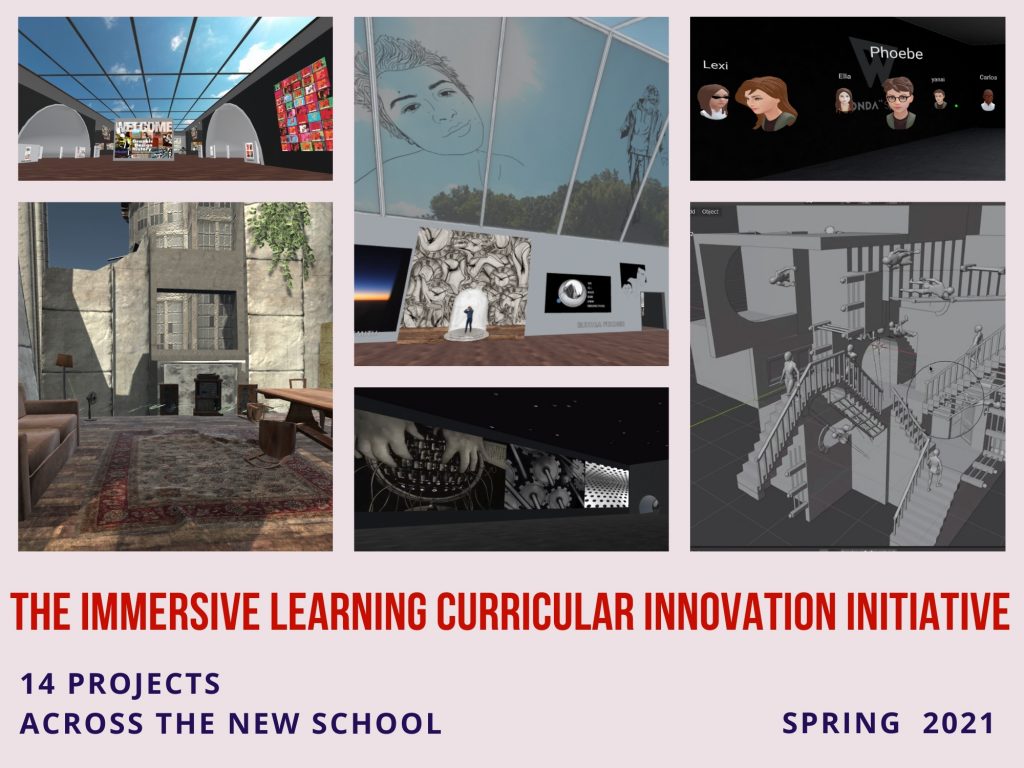
Immersive Learning Curriculum Innovation Initiative Spring 2021

We are thrilled to share the proposals selected for the Spring 2021 Immersive Learning Curriculum Innovation Initiative. Led by Maya Georgieva, Director of Education Futures/XReality Center, the faculty and students in the courses are prototyping, building experiences, meeting and collaborating in social virtual worlds. During the course of the spring semester faculty and students are exploring teaching and learning with 360 video, social virtual worlds and tools like Blender, Unity, WondaVR, The Pico and Oculus Quest 2 headsets and others.
Project Title: Virtual Spaces as Sites for Participatory Design-based Research; and Learning from Experiences at the End of Life: virtual reality and co-creative pedagogies
Faculty: John Bruce
Courses: CINEMATIC TROPES as DESIGN PROCESS; and MFA TRANSDISCIPLINARY DESIGN SUPERSTUDIO
Program/ School: PARSONS SCHOOL OF DESIGN: DESIGN STRATEGIES
Project Title: DIMENSIONS: Mixed Reality Environments
Faculty: Miyö Van Stenis
Course: DIMENSIONS
Program/ School: PARSONS PARIS: PARIS ART, MEDIA & TECHNOLOGY
Project Title: Sound and Virtual Space
Faculty: John Roach
Course: SOUND AND VIRTUAL SPACE
Program/ School:PARSONS SCHOOL OF DESIGN: PARSONS FIRST YEAR
Project Title: VR and AR Filmmaking
Faculty: Faculty: Al Hallak
Course: EDITING
Program/ School: EUGENE LANG COLLEGE LIB ARTS: CULTURE AND MEDIA
Project Title: Redesigning Time
Faculty: Joseph Ayers
Course: TIME
Program/ School: PARSONS SCHOOL OF DESIGN: PARSONS FIRST YEAR
Project Title: Dimension in the Archive
Faculty: Courtney Stephens
Course: THE ARCHIVAL IMAGINATION
Program/ School: EUGENE LANG COLLEGE LIB ARTS: CULTURE AND MEDIA
Project Title: Keeping It (Virtually) Real: Hip Hop Arts Ed in XR
Faculty: Samuel Sellers
Course: HIP HOP PEDAGOGY & PRACTICE
Program/ School: EUGENE LANG COLLEGE LIB ARTS: THE ARTS
Project Title: Immersive Nonfictions
Faculty: Amir Husak
Course: DOC PRACTICE & EMERGING MEDIA
Program/ School: SCHOOLS OF PUBLIC ENGAGEMENT: MEDIA STUDIES
Project Title: Soothe me
Faculty: Faculty: Niberca (Gigi) Polo
Course: MENTAL HEALTH BY DESIGN
Program/ School: PARSONS SCHOOL OF DESIGN: PARSONS FIRST YEAR
Project Title: Graphic Design History Immersion Rooms – Periods of Graphic Design and Student Galleries
Faculty: John Battista De Santis
Course: Graphic Design History
Program/ School: PARSONS: CONTINUING AND PROFESSIONAL EDUCATION
Project Title: Live Performance and Video Screening rooms for TOPICS: PERFORMANCE/MUSIC
Faculty: Jonathon Rosen & Robert Sikoryak
Course: TOPICS: PERFORMANCE/MUSIC SPRING 2021
Program/School: PARSONS SCHOOL OF DESIGN: ILLUSTRATION
SUMMER and FALL 2021
Project Title: The ‘Democracy & Diversity’ Summer Graduate Institute in Wroclaw, Poland – Summer 2021 – organized by the Transregional Center for Democratic Studies (TCDS) at NSSR
Faculty: Elżbieta Matynia, Sociology, NSSR and director of the Transregional Center for Democratic Studies (TCDS)
Project Title: Implementing VR/AR in Mindfulness-based classes
Faculty: Latha Poonamallee
Course: Fall 2021